



The regulatory function in healthcare industries is vital in making safe and effective healthcare products available worldwide. Individuals who ensure regulatory compliance and prepare submissions, as well as those whose main job function is clinical affairs or quality assurance are all considered regulatory professionals.
The regulatory professional's roles and responsibilities often begin in the research and development phases, moving into clinical trials and extending through premarket approvals, manufacturing, labelling and advertising and post market surveillance. (RAPS.org, accessed on 30 January 2020)
Regulatory affairs is a profession developed from the desire of governments to protect public health by controlling the safety and efficacy of products in areas including pharmaceuticals, veterinary medicines, medical devices, pesticides, agrochemicals, cosmetics and complementary medicines, and by the companies responsible for the discovery, testing, manufacture and marketing of these products wanting to ensure that they supply products that are safe and make a worthwhile contribution to public health and welfare. A new class of professionals emerged to handle these regulatory matters for companies. (TOPRA.org, accessed on 30 January 2020)
There are many laws, regulations and guidance documents that are applicable to the therapeutic development industry. The governing body in Australia is the Therapeutic Goods Administration (TGA) www.tga.gov.au. The way companies and institutions implement the laws, regulation and guidance documents are through standard operating procedures (SOPs).
Regulatory Affairs Associate
Senior Regulatory Affairs Associate
Regulatory Affairs Specialist
Senior Regulatory Affairs Manager
Regulatory Affairs Director
Regulatory Affairs Assistant
RA/QA Manager
Regulatory professionals are employed in industry, government and academia and are involved with a wide range of products including:
pharmaceuticals
medical devices
in vitro diagnostics
biologics and biotechnology
nutritional products
cosmetics
veterinary products
Regulatory professionals come from diverse backgrounds. Most regulatory professionals have earned a bachelor's degree, and more than half have an advanced degree, most often in a scientific or technical field. In addition, regulatory professionals usually have experience in other careers before transitioning into regulatory affairs.
Although there are some university degree and graduate certificate programs in regulatory affairs and related areas, experience is a key asset for regulatory professionals. Valuable skills include project management and organisation, negotiation and communication, and the ability to learn from the experience of others, both inside and outside the organisation.
Continuing education and professional development are critical to the regulatory professional. Regulatory professionals must keep up to date with regulatory policies and procedures for one or more countries, as well as maintain an understanding of the scientific and technical background of healthcare products. (raps.org, accessed on 30 January 2020)
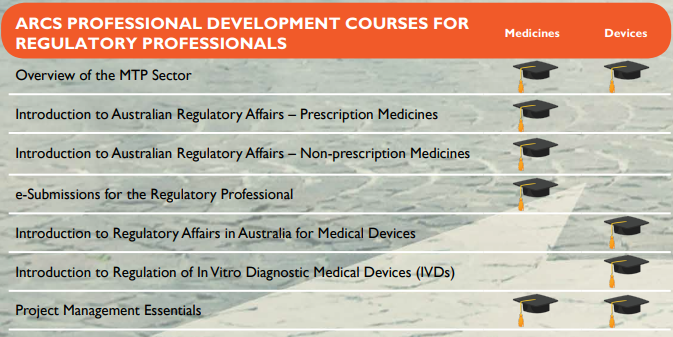
If you are thinking about a career in regulatory affairs, ARCS is offering a range of workshops addressing essential requirements to set you up on your preferred career path.
|
Entry level/introductory |
Intermediate/advanced |
Related workshops |
|
Introduction to Regulatory Affairs in Australia for Prescription & Non-Prescription Medicines |
Regulation of Pharmaceuticals in the European Union |
Making Sense of Statistics |
|
Introduction to Regulatory Affairs in Australia for Medical Devices |
Regulation of Pharmaceuticals in the USA |
Project Management Essentials |
|
Introduction to Regulation of In Vitro Diagnostic Medical Devices (IVDs) |
Australian eSubmissions for the Regulatory Professional |
Overview of Drug Development |
|
A Global Approach to Clinical Evidence for Medical Devices |
Pharmacovigilance Inspections |
Overview of the Medical Technology, Biotechnology and Pharmaceutical Sector |
|
An Introduction to Pharmacovigilance: A Theoretical Approach |
Pharmacovigilance in Practice: The Pharmacovigilance Professional |
|
|
|
Applying Bioavailability and Bioequivalence (BABE) Guidelines |
|
|
|
Registration of Biologicals and Biotechnological Products |
|
Monitor some of the job search portals and search for regulatory affairs positions. This should give you a better idea of what roles are available and who is recruiting. ARCS membership provides access to the weekly Member News.
Identify potential employers and approach them directly about entry level positions or graduate programs. There are a range of specialised recruiters for careers in regulatory affairs.


%20(2).jpg)


-%20Ausbiotech24.jpg)


